
Is Your Team Ready for AI?
We work with organizations to ensure they have the knowledge and conditions to effectively implement AI. Our new tool evaluates whether teams are prepared for AI integration and where support is needed to scale. We identify your unique opportunities and barriers, transforming your approach to the latest technology and guiding your leaders to act with clarity as it becomes part of daily work.
Aktum Pulse™ & AI Dimension
A rapid diagnostic of organizational capacity for change, sustainability, and growth
How Leaders Use Aktum Pulse™
-
Case Study Overview
A mid-size biotech scaling into early clinical development introduced an AI-enabled workflow for literature review and protocol drafting. Adoption varied across teams. Leadership deployed the Ready and AI-Ready assessment to pinpoint where AI readiness was lagging.
Generated Insights
Overall readiness to change was high (Ready: 90), but AI-specific readiness was materially lower (AI Ready: 63; Index: 70%). Department-level filtering revealed concentrated gaps in Clinical Operations and Regulatory/Medical Writing, where clarity, confidence, and enablement around AI use were insufficient for consistent adoption.
Recommended Action & Impact
Leaders implemented targeted guardrails. Clinical Operations received defined AI use cases and compliance-safe templates, while Regulatory/Medical Writing established clear authoring standards and review checklists. Within six weeks, the AI Ready score rose to 72 (Index: 77%), reflecting stronger confidence and more consistent adoption.
The Value
By identifying department-specific constraints, leaders improved AI adoption without increasing risk. The tool enabled focused interventions that accelerated integration while protecting quality and compliance.
-
Case Study Overview
A healthcare system was evaluating several major AI investments across clinical and operational functions. The Chief Strategy Officer knew some areas were ready to adopt AI quickly while others lacked the clarity or capability to do so, and did not want to rely on assumptions when allocating resources.
How the Insights Helped
Leaders reviewed results by service line, role, and location to identify where AI readiness was strong and where gaps in trust, enablement, or execution could limit return on investment.
Data-Driven Decisions
Rather than funding AI initiatives uniformly across the system, the CSO prioritized investment in areas with higher readiness and sequenced support for teams needing clearer standards, training, or governance before scaling further adoption.
The Business Impact
AI investments generated faster adoption and measurable impact where readiness was strong, while risk and rework were reduced in lower-readiness areas. The organization improved ROI on AI spending and avoided costly missteps during rollout.
-
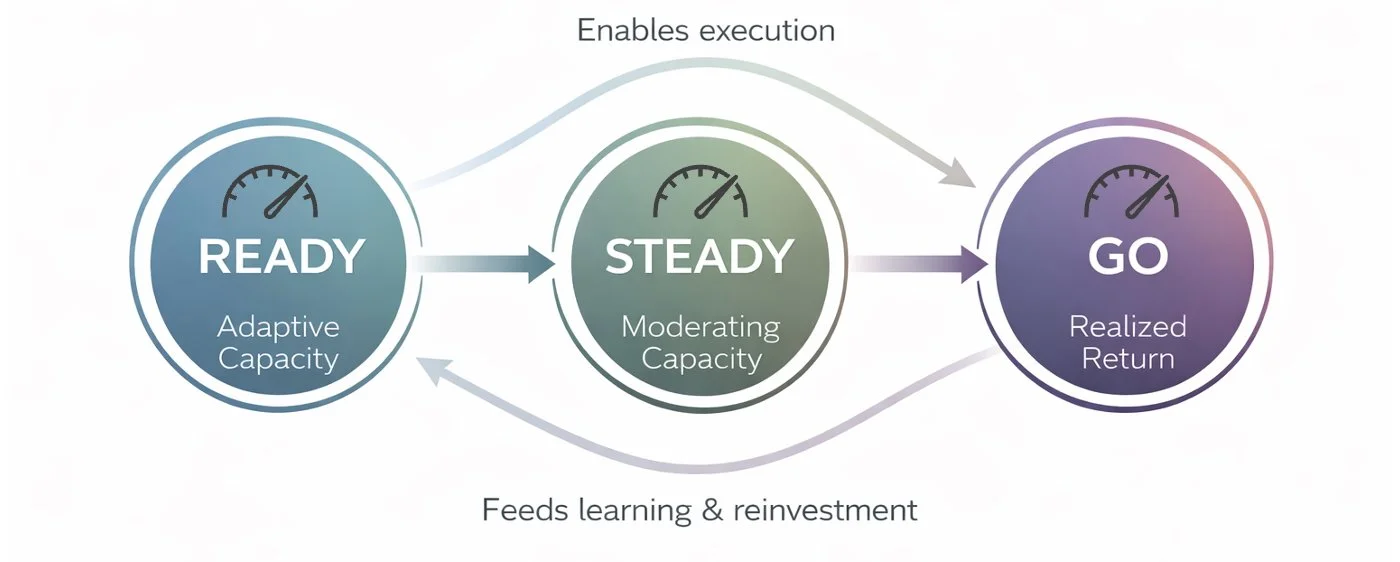
Once AI is implemented, the full AI Ready–Steady–Go framework is applied to assess operational capacity in an AI-enabled environment. By deploying Aktum Pulse™ with the AI Dimension, leaders can track overall operational capacity alongside AI-specific indicators over time - showing where adoption is accelerating, where friction is emerging, and what to address to sustain performance.